
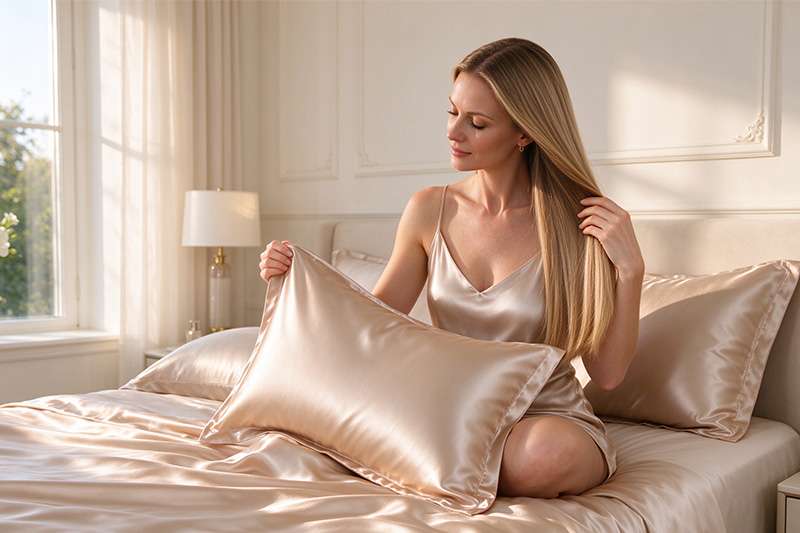
Pull up any marketplace and search “silk pillowcase.” The top twenty listings make the same three promises: healthier hair, fewer split ends, less breakage. Roughly none of them explain why. And several say things that would make a compliance lead put down their coffee.
That’s the frustrating part. The benefit is real. It’s just almost always explained lazily — and then inflated one notch past the point where anybody could defend it.
So here’s the version we’d want our own buyers to hand to their marketing team. What actually happens between hair and fabric, what doesn’t happen no matter what the listing claims, and how to write copy that sells without inviting a letter.
The honest answer: yes — but for mechanical reasons, not medical ones. A silk pillowcase helps hair by reducing friction and helping it hold onto moisture overnight. That’s the claim. It’s smaller than what most product pages promise, and it works better anyway.
The Short Answer
A silk pillowcase helps hair in three ways:
- Less friction — silk fibers are smooth at the microscopic level, so hair glides instead of catching
- Better moisture retention — silk doesn’t strip moisture out of hair the way cotton does
- Less tangling overnight — less friction means fewer knots, less breakage when brushing in the morning
What it does not do: regrow hair, repair split ends, or treat any medical condition. More on that below, because it’s where brands get into trouble.
What’s Actually Happening (The Simple Version)
You don’t need a materials science degree to explain this to your team or your customers. It comes down to two things.
1. Friction
Hair damage from sleeping isn’t mysterious. It’s mechanical. You turn your head somewhere between 30 and 40 times a night, and every turn drags your hair across the fabric surface.
Now picture the surface at the microscopic level:
- Cotton is a plant fiber with an irregular, scaly surface. Under magnification it looks like rope — twisted, uneven, covered in tiny hooks. Hair catches on it.
- Silk is a continuous protein filament — one unbroken strand extruded by the silkworm, up to 1.6km long from a single cocoon. It’s smooth and consistent along its whole length. Hair slides across it.
That’s the entire mechanism. Less friction per movement, times thirty-odd movements a night, times three hundred and sixty-five nights — that’s the difference between hair that holds up and hair that frizzes, splits, and tangles.
2. Moisture
This one gets overlooked, and it’s arguably the more important of the two for textured and curly hair.
Cotton is absorbent. That’s why it’s used for towels. A cotton pillowcase pulls moisture out of your hair all night — along with whatever leave-in conditioner or hair oil your customer applied before bed.
Silk is different. It can absorb 10–30% of its own weight in moisture, but it doesn’t aggressively wick moisture away from what’s touching it. The products your customer put on their hair stay on their hair.
For anyone following a curly hair routine — leave-in, oil, overnight treatment — this matters a lot. It’s also why silk bonnets became a staple in the textured hair community long before they crossed over into mainstream retail.
What a Silk Pillowcase Doesn’t Do
We’re going to be direct here, because this is the part that protects your brand.
It doesn’t grow hair. Hair growth happens at the follicle, and it’s driven by genetics, hormones, nutrition, and overall health. A pillowcase touches the hair shaft, not the follicle. There is no plausible mechanism by which fabric contact changes growth.
It doesn’t repair damage. Once a hair shaft is split, it’s split. Silk reduces new mechanical damage. It can’t undo what’s already done.
It doesn’t treat hair loss. Androgenetic alopecia, telogen effluvium, alopecia areata, postpartum shedding — these are medical conditions with medical causes and medical treatments. A pillowcase is not one of them.
The honest framing is: silk reduces mechanical damage during sleep. That’s the claim. It’s a real benefit, it’s defensible, and it’s genuinely valuable to the customer who wakes up with a knotted mess every morning.
What You Can Say: A Wording Guide for Your Marketing Team
This is the part worth forwarding to whoever writes your product copy.
| Don’t say | Say instead |
|---|---|
| “Prevents hair loss” | “Reduces breakage from friction during sleep” |
| “Repairs split ends” | “Helps prevent new split ends caused by friction” |
| “Clinically proven to grow hair” | “Smooth fiber surface means less friction than cotton” |
| “Anti-aging for your hair” | “Helps hair retain moisture overnight” |
| “Recommended by dermatologists” | Only if you have that documentation — and can produce it |
The rewritten wording in the right column is nearly as compelling as the original. “Reduces breakage from friction” is more specific and more believable than “prevents hair loss” anyway.
The Spec Decisions Behind the Hair Claim
If your product story is built on the hair benefit, three spec choices determine whether the product actually delivers it.
1. Weave matters most
Charmeuse (silk satin) is what gives silk its slip. The weave floats long threads across the surface, creating that smooth, continuous face. It’s the standard for pillowcases for a reason — it’s the weave that delivers the friction benefit.
Other weaves behave differently. Crepe de chine has a matte, slightly pebbled surface that’s beautiful and durable but less slippery. Twill is structured and holds shape well. Chiffon is sheer and weightless. For a product whose main selling point is hair protection, charmeuse is the safe, correct spec. Here’s how the main silk fabrics compare.
2. Momme matters for durability
- 16mm — light and soft, but it wears out faster. For a pillowcase that gets washed weekly, it’s under-specced.
- 19mm — the market standard for silk pillowcases. Good durability, good drape, good price-to-quality ratio.
- 22mm — denser, better hand feel, holds up longer. This is the premium tier most brands upgrade to.
- 25mm and above — heavy silk, typically home furnishing and cold-weather products.
For a product whose value proposition is “gentler on your hair,” 19–22mm charmeuse is where you want to be. Below that, the product won’t survive long enough for the customer to notice the benefit. Our momme guide has the full breakdown by product type.
3. Fiber quality matters
Grade 6A mulberry silk has long, continuous filaments. Cheaper silk grades have shorter fibers that break more easily, creating rough spots and pilling — which is friction, the exact thing your product is supposed to reduce. The grade isn’t a vanity metric; it’s part of the mechanism. We walk through how to verify it here.
Which Products to Build Around the Hair Benefit
The hair-protection story isn’t limited to pillowcases. It’s the connective tissue of the whole silk accessories category:
- Silk pillowcases — the anchor product and the easiest entry point for customers
- Silk bonnets — full overnight protection, strongest with textured and curly hair customers
- Silk scrunchies — daytime friction reduction; the lowest-priced, highest-attach-rate item in the category
- Silk sleep masks — same skin-gentleness argument, different use case
- Silk sleep sets — pillowcase plus scrunchie plus mask, the highest-value SKU structure in the category
The strategic point: customers rarely shop these in isolation. Pillowcase leads to scrunchie leads to bonnet. Brands that plan the line as a system, not a set of unrelated SKUs, get much better repeat rates. Our properties guide explains what makes silk behave this way across products.
Who Buys Silk Pillowcases for Hair Reasons
If you’re deciding whether the hair angle fits your audience, these are the segments driving demand:
- Curly and textured hair customers — the most established and most loyal segment. For them, this isn’t a luxury upgrade; it’s routine.
- Chemically treated and color-processed hair — bleached, permed, relaxed, or keratin-treated hair is more fragile and more prone to friction damage.
- Extensions and protective styles — anything that can’t be re-oiled by the scalp benefits from less moisture loss overnight.
- Lash extension clients — a slightly different angle, but the same low-friction logic. If you’re already selling contoured sleep masks, the crossover is obvious.
- Beauty-sleep and self-care positioning — the broadest segment, and the one most driven by gifting.
Mistakes We See Brands Make
Building the whole product page on “prevents hair loss.” It’s the single most common overclaim in the category, and the easiest one for a regulator or a marketplace to flag.
Under-speccing the momme. A 16mm pillowcase that pills after three months generates a return and a bad review, and it undercuts the exact benefit you’re selling.
Confusing silk with satin in the copy. If a product page says “silk-feel” or “silky satin,” the customer reading it often believes they’re buying silk. That’s a labeling problem, not a marketing win.
Not telling customers how to wash it. The hair benefit depends on the surface staying smooth. Harsh detergent and heat degrade it. A care card is cheap insurance.
Treating the pillowcase as a one-off SKU. It performs best as the entry point to a sleep set.
FAQ: What Brand Buyers Ask Us
1. Is there actual research behind silk pillowcases and hair?
There’s limited formal clinical research on silk pillowcases specifically — we’re not going to pretend otherwise. What is well established is the mechanism: mechanical friction damages the hair cuticle, and fabric surface texture determines how much friction occurs. Silk’s smooth continuous filament produces less friction than cotton’s irregular staple fiber. That’s materials science, not marketing. The honest pitch to customers is mechanism, not clinical proof.
2. Can we put “clinically proven” on our packaging?
Only if you have testing that supports it and can produce that documentation on request. “Clinically proven” is a substantiation claim — using it without backing is exactly what draws FTC attention in the US and creates problems under EU cosmetic rules. If you don’t have the testing, describe the mechanism instead.
3. What momme should we spec for a hair-benefit product?
19mm is the standard. 22mm for premium. Below 19mm, you’re trading away the durability that lets the customer experience the benefit long-term — and pillowcase weight is where fabric cost is most visible, so it’s worth getting right.
4. How do we know a supplier’s silk is actually Grade 6A?
Ask for the fiber composition in writing, plus a test report. Then verify it yourself — the burn test and bleach test are both things your QC team can run on a sample in minutes. Full walkthrough here.
5. Should the pillowcase be the hero product or part of a set?
Depends on your positioning. As a standalone product it works, but it works harder as the entry point to a sleep set — the attach economics are much better. If you sell through retail or gifting channels, the set is almost always the stronger SKU. See how we structure sleep sets.
6. What certifications should we ask for?
OEKO-TEX Standard 100 is the baseline for anything sold in Europe or through major US retailers. ISO9001 covers quality management systems. SGS and Intertek test reports document specific test results. One thing worth getting right in your own documentation: SGS and Intertek are testing organizations, not certification bodies — an “SGS certificate” is usually a test report, and retail compliance teams will notice if you call it a certification. Details on our certifications.
The Bottom Line
Does a silk pillowcase help hair? Yes — by reducing friction and helping hair keep its moisture overnight. That’s a real, mechanical, explainable benefit, and it’s the one your marketing should lead with.
What it isn’t is a treatment. The brands that get this wrong don’t just risk regulatory letters — they set expectations the product can’t meet, which shows up in returns and reviews.
For sourcing, three things decide whether the product delivers: charmeuse weave for the slip, 19–22mm for the durability, and Grade 6A fiber so the surface stays smooth. Get those right and the benefit your marketing promises is the benefit your customer experiences.
Building a Silk Pillowcase Line?
We’ve been making 6A grade mulberry silk pillowcases in Suzhou for 19 years — 16 to 30 momme, custom colors, digital and screen printing, private labeling, and gift box packaging.
Request free samples · Explore custom silk pillowcase options
Questions? Email us at info@yashasilk.com or message us on WhatsApp +86-150 6254 6003.


