
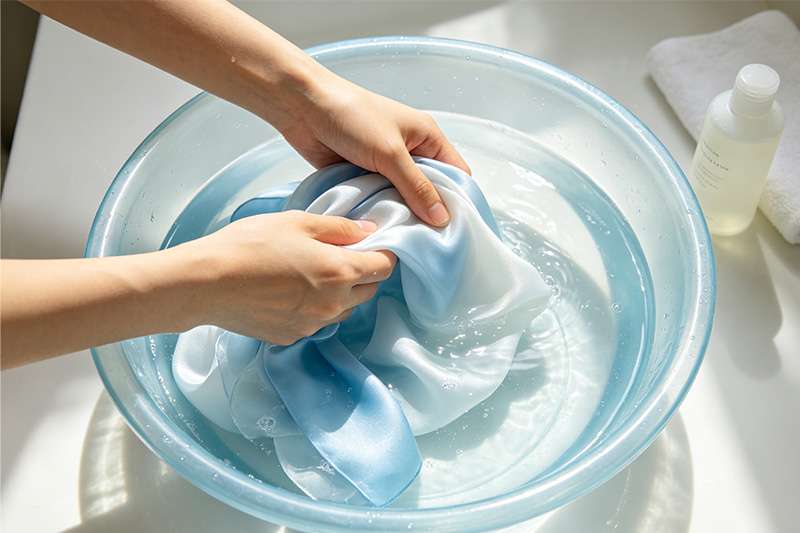
Silk scarves are different from silk pillowcases. They’re lighter — usually 8 to 14 momme instead of 19 or 22. They’re printed, often with designs where ink penetration matters. Many have hand-rolled hems that can pucker if treated roughly. And they live close to skin, hair, perfume, and makeup, so the stains they pick up aren’t the stains a pillowcase picks up.
So this guide does two things. First, it answers the question properly — how to actually clean a silk scarf, step by step. Second, it gives you the brand-side context: what to put on your care card, what to put on your product page, and how to cut the care-related returns before they happen.
The Quick Answer
For those who just want the method:
- Hand wash in cold water (30°C / 86°F max) with a pH-neutral liquid detergent made for silk or wool
- Swish gently for 2–3 minutes — never scrub, twist, or wring
- Rinse in cold water until the water runs clear
- Optional: add a teaspoon of white hair conditioner to the final rinse for extra softness
- Press water out gently — roll the scarf in a clean towel, never wring it
- Dry flat in the shade, away from direct sunlight and heat
- Iron on low heat from the back, while slightly damp — or use a handheld steamer
That’s the whole process. Now let’s go through it properly, because the details are where scarves get ruined.
Why Scarves Need Different Care Than Other Silk Products
If you’ve read our general silk care guide, some of this will sound familiar. But scarves have three specific vulnerabilities, and your customers need to know about them.
1. Lightweight fabric
Scarf-weight silk (8–14 momme) is thinner and more delicate than bedding-weight silk. It dries faster, which is nice, but it also snags easier, stretches out of shape when wet, and shows water spots more readily. A 22 momme pillowcase forgives a rough wash. A 12 momme chiffon scarf doesn’t.
2. Printed designs
This is the big one. Most silk scarves are printed, and print durability depends on the printing method:
| Printing Method | Wash Durability | Notes for Brands |
|---|---|---|
| Digital print | Good with gentle washing | Unlimited colors, low MOQ (from 10 pcs/design). Ink penetration is only 50–60% on the back side. |
| Double-sided digital | Very good | Ink on both sides — more durable overall. Higher MOQ (50 pcs/design) and price. |
| Screen printing | Best | The traditional method used by heritage luxury houses. Deepest penetration, most wash-resistant. MOQ 100 pcs/color. |
The rule that protects all three: cold water, pH-neutral detergent, minimal agitation. Heat and alkaline detergent are what fade prints — not washing itself.
3. Hand-rolled hems
A hand-rolled hem is a mark of craftsmanship — artisans roll and stitch the edge by hand so the hem disappears into the fabric. It’s what separates a premium scarf from a machine-finished one. But wet silk is heavy, and if you hang a wet scarf to dry, gravity pulls on those tiny hand stitches. The hem can pucker or the fabric can stretch near the edges.
That’s why flat drying isn’t optional for scarves — it’s what protects the hem.
Hand Washing: The Full Method
Hand washing is the default for silk scarves. Here’s the version your customers should follow.
What you need:
- A clean basin or sink
- Cold water (30°C / 86°F max — if it feels warm on your wrist, it’s too hot)
- pH-neutral liquid detergent for silk or wool
- A clean, dry, light-colored towel
Steps:
- Fill the basin with cold water and add a small amount of silk detergent. Less is more — half a teaspoon for one scarf is usually enough.
- Submerge the scarf and gently swish it with your hands for 2–3 minutes. Think “gently moving water through fabric,” not scrubbing.
- Soak no longer than 5 minutes. Prolonged soaking dulls prints and can cause dye to bleed, especially on deeply saturated colors.
- Rinse under cold running water until all the detergent is gone. The water should run completely clear.
- Optional softening step: add a teaspoon of white hair conditioner to a basin of fresh cold water, swish the scarf through it for 30 seconds, then rinse once more. Silk is a protein fiber — the same one as your hair — so hair conditioner genuinely works as a softener.
- Remove excess water by rolling, not wringing. Lay the scarf flat on a clean towel, roll the towel up loosely with the scarf inside, and press gently. The towel absorbs the water; the scarf never gets twisted.
- Unroll and dry flat on a fresh dry towel or a drying rack, away from sunlight, radiators, and hairdryers. Reshape the scarf gently while it’s damp.
- Iron while slightly damp, on low heat, from the reverse side. If the scarf has already dried completely, use the steam setting or a pressing cloth. Never iron directly on top of a print at high heat.
What never to do:
- No bleach, no fabric softener (the conditioner trick replaces it)
- No tumble drying — heat destroys silk fibers and can crack prints
- No dry cleaning as a routine (more on this below — it’s nuanced)
- No soaking in soapy water overnight
- No hanging to dry — this stretches the fabric and pulls the hems
Can You Machine Wash a Silk Scarf?
Short answer: we don’t recommend it, and our care guidance says hand wash. But let’s be honest about how customers actually behave. Some customers will machine wash no matter what the label says. So the practical question for your brand is: what happens if they do?
On a delicate cycle, cold water, silk detergent, inside a mesh laundry bag, a scarf-weight silk scarf can survive an occasional machine wash. A 14 momme twill scarf with screen printing will handle it better than an 8 momme chiffon with digital print. The risks are snagging (on zippers, hooks, or the drum itself), agitation damage, and print dulling over repeated cycles.
Our recommendation for your care materials: state “hand wash recommended” as the primary instruction. If you want to acknowledge machine washing, phrase it as a fallback: “If machine washing is unavoidable: mesh bag, delicate cycle, cold water, silk detergent, wash alone.” That phrasing manages expectations without encouraging the behavior.
One more thing — “machine washable” is a claim some brands want on the label because it reduces purchase hesitation. Be careful here. If a customer machine washes a printed scarf and the print dulls, “machine washable” on your label is a return reason in writing. Our care-label guide covers the compliance side of this.
Should Silk Scarves Be Dry Cleaned?
This is where silk scarves differ from bedding, and it confuses customers constantly.
For routine cleaning: no. Dry cleaning solvents are harder on lightweight silk than people assume, and repeated dry cleaning can dull the finish and affect prints. It’s also expensive relative to the product — nobody dry cleans a scarf they wear every week.
For specific situations: yes, and it’s worth knowing when:
- Deeply saturated or dark colors with visible dye bleed — if the rinse water shows color even after a gentle wash, stop and take it to a professional
- Vintage scarves or scarves with unknown fiber content — always dry clean
- Structured pieces — stoles, shawls with embellishment, or anything with beading or sequins
- Set-in stains that home treatment didn’t fix — a professional cleaner can treat what a customer can’t
The practical version for your care card: “Hand wash recommended. Dry clean for stubborn stains or delicate trims.” That’s honest, it protects the product, and it doesn’t push customers toward an expensive habit they don’t need.
Stain Removal: The Scarf-Specific Guide
Scarves collect a specific set of stains — makeup, perfume, hair products, neck oils — that pillowcases mostly don’t. Here’s how to handle the common ones.
- Makeup (foundation, lipstick)
Blot — don’t rub — with a damp cloth and a tiny drop of silk detergent. Rinse cold. Lipstick often has an oil base, so work from the outside edge of the stain inward to stop it spreading.
- Perfume
Perfume stains are sneaky because they’re invisible until they set — then they show as darker patches or, worse, they eat the dye over time. The fix is prevention: spray perfume first, let it dry, then put the scarf on. For existing spots, dab with cold water and mild detergent quickly.
- Sweat and body oils
Soak the stained area in cold water with silk detergent for 15–20 minutes, then hand wash normally. For yellowing on light-colored scarves, a small amount of white vinegar in the rinse water helps neutralize odor and brighten.
- Hair oil and leave-in products
Same as sweat — cold water soak with silk detergent. The key is acting within a few days; hair oils oxidize and become much harder to shift.
- Oil-based stains (food, cosmetics)
Blot excess immediately, then cover the spot with an absorbent powder — cornstarch or talc — and let it sit for several hours to draw out the oil. Brush off gently and hand wash.
No alcohol-based stain removers, no hydrogen peroxide, no lemon juice on silk. These are common household “hacks” that strip dye from silk — and on a printed scarf, they’ll take the design with it.
Drying, Ironing, and Storage
- Drying
Flat, in the shade, always. Direct sun fades prints surprisingly fast — a scarf left on a sunny windowsill can lose color depth in a few afternoons. Heat sources (radiators, hairdryers) make silk brittle.
- Ironing
Low temperature, reverse side, slightly damp. For printed scarves, iron from the back or place a pressing cloth between the iron and the print. A handheld steamer works well for scarves because there’s no direct contact — it’s the safest option for hand-rolled hems.
- Storage
Three rules:
- Store loosely folded or rolled — hanging stretches lightweight silk over time
- Breathable storage only — a cotton bag or a drawer with airflow. Sealed plastic traps moisture and can yellow light-colored silk
- Away from direct light — even indoor light fades prints slowly over months
One tip from our factory floor: roll scarves around a cardboard tube (the kind from wrapping paper) for long-term storage. No fold lines, no stress on the hems, and customers can see the print at a glance.
FAQ: What Brand Buyers Ask Us About Scarf Care
1. What momme weight is easiest to care for?
Heavier scarves are more forgiving. A 14 momme twill scarf handles washing better than an 8 momme chiffon — more fiber density, more durable print base. If your customer base is first-time silk buyers and you’re worried about care complaints, spec 12–14 momme. If the product’s identity is weightless drape and sheerness, 8–10 momme is the right choice — just invest more in the care card. Our momme guide has the full weight breakdown.
2. Which printing method survives washing best?
Screen printing. It’s the traditional method the heritage luxury houses use — deepest ink penetration, most wash-resistant, vivid on both sides. Digital print offers unlimited colors and low MOQs (from 10 pieces per design), but the ink penetration is 50–60% on the back and the front needs gentler washing over its lifetime. Double-sided digital printing splits the difference. If your customers will wash frequently, tell us — we’ll steer you to the right method at the sampling stage.
3. Can I put “dry clean only” on the label instead?
You can, and some brands do because it transfers all care responsibility to the customer. But it’s a worse customer experience — dry cleaning a scarf costs a meaningful fraction of the scarf’s price, and most customers won’t do it. They’ll either hand wash anyway (fine) or stop wearing the scarf (worse). “Hand wash recommended” with real instructions is the better label.
4. Will the dye bleed on the first wash?
With properly finished, dye-fixed silk — no, or barely. This is a factory quality question. Cheap silk scarves skip the dye-fixing step, and their first wash turns the basin blue. When we produce scarves, dye fixing and wash testing are part of our QC before anything ships. It’s a fair question to ask any supplier: “Is the dye fixed? What’s your wash-fastness testing standard?” If they can’t answer, test a sample yourself before committing.
5. How should customers store scarves between seasons?
Clean first — body oils and perfume residue attract moths and cause yellowing in storage. Then loosely roll (not fold), wrap in breathable cotton or acid-free tissue, and store in a drawer or box away from light. No plastic bags, no mothballs — camphor damages silk.
6. Can we include your care content on our own product pages?
Yes. If you’re a brand sourcing from us, you’re welcome to adapt this guide for your customer education — product pages, care cards, email flows. Clear care instructions help the whole category by preventing bad experiences. Talk to us about care card printing with your order.
In Conclusion
Cleaning a silk scarf properly comes down to one idea: treat it like hair. Cold water, gentle cleanser, no heat, no twisting. Everything else — the towel-rolling, the flat drying, the reverse-side ironing — follows from that.
For brands, the bigger opportunity is upstream of the wash: a scarf-specific care card, clear product page wording, and a supplier who dye-fixes and wash-tests before shipping. Those three things prevent the returns that generic care instructions don’t.
Sourcing Silk Scarves for Your Brand?
We’ve been weaving and printing mulberry silk scarves in Suzhou for 19 years — 8 to 14 momme, digital and screen printing, hand-rolled hems, low MOQs, and full OEM/ODM service.
Request free samples · Explore our custom scarf options
Questions? Email us at info@yashasilk.com or message us on WhatsApp +86-150 6254 6003.


